
 Automatika Data Room
Financial Outlook#
We built this page as a summarized read of our financial model. It covers the three questions investors most often start with: how we plan to spend a Seed round, how the team is expected to grow, and where revenue comes from as EMOS scales.
A detailed financial model (revenue build, per-quarter cash flow, unit economics, cohort assumptions) is available on request. See the note at the bottom of the page.
Use of Funds#
We are raising €6M to fund an 18-month runway starting November 2026 (through April 2028) delivering the first stable release of EMOS along the milestones on our product roadmap — the unified open-source release of EMOS, zero-touch enterprise onboarding, expanded hardware support, and the first wave of paid OEM and enterprise deployments.
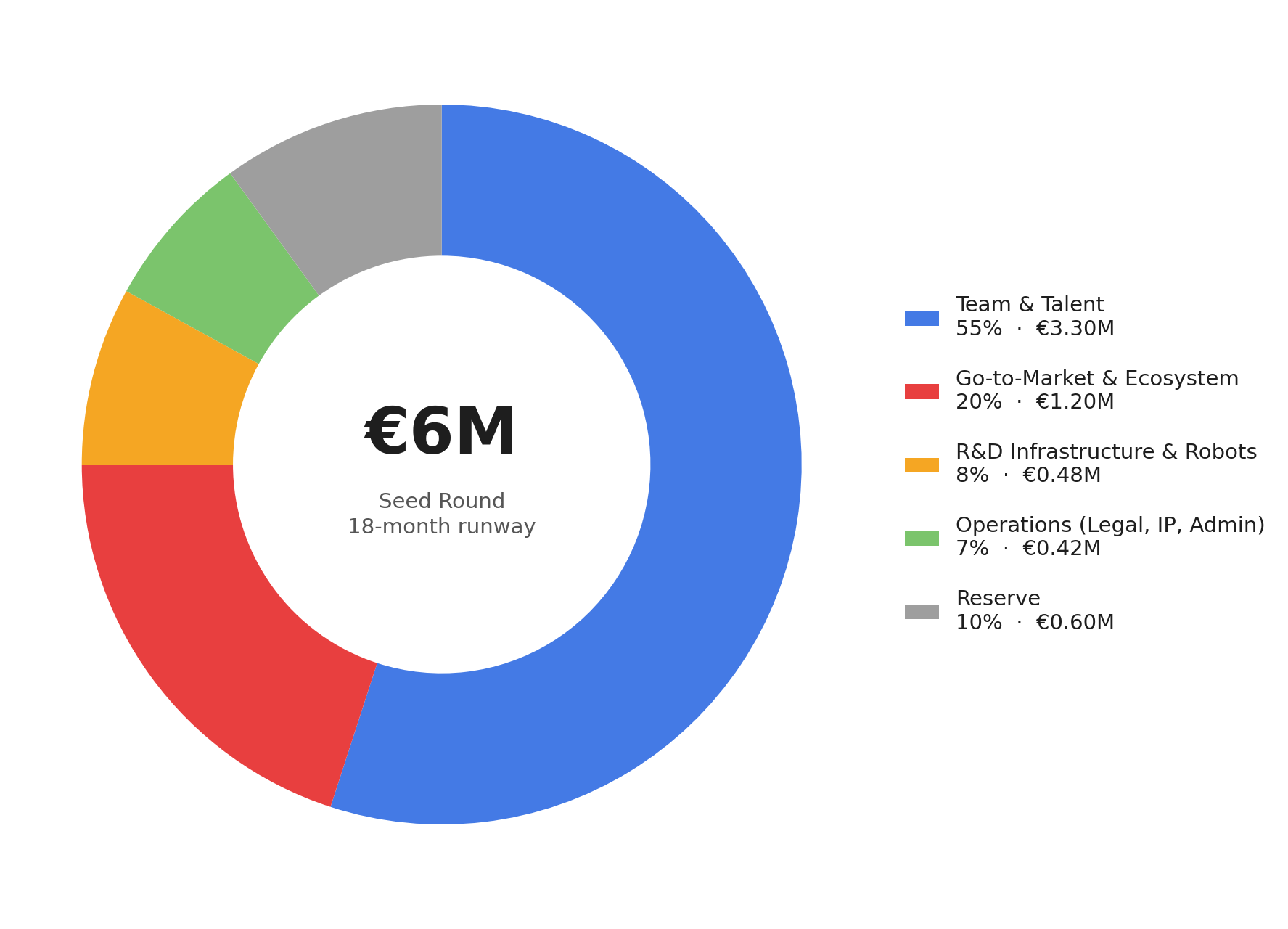
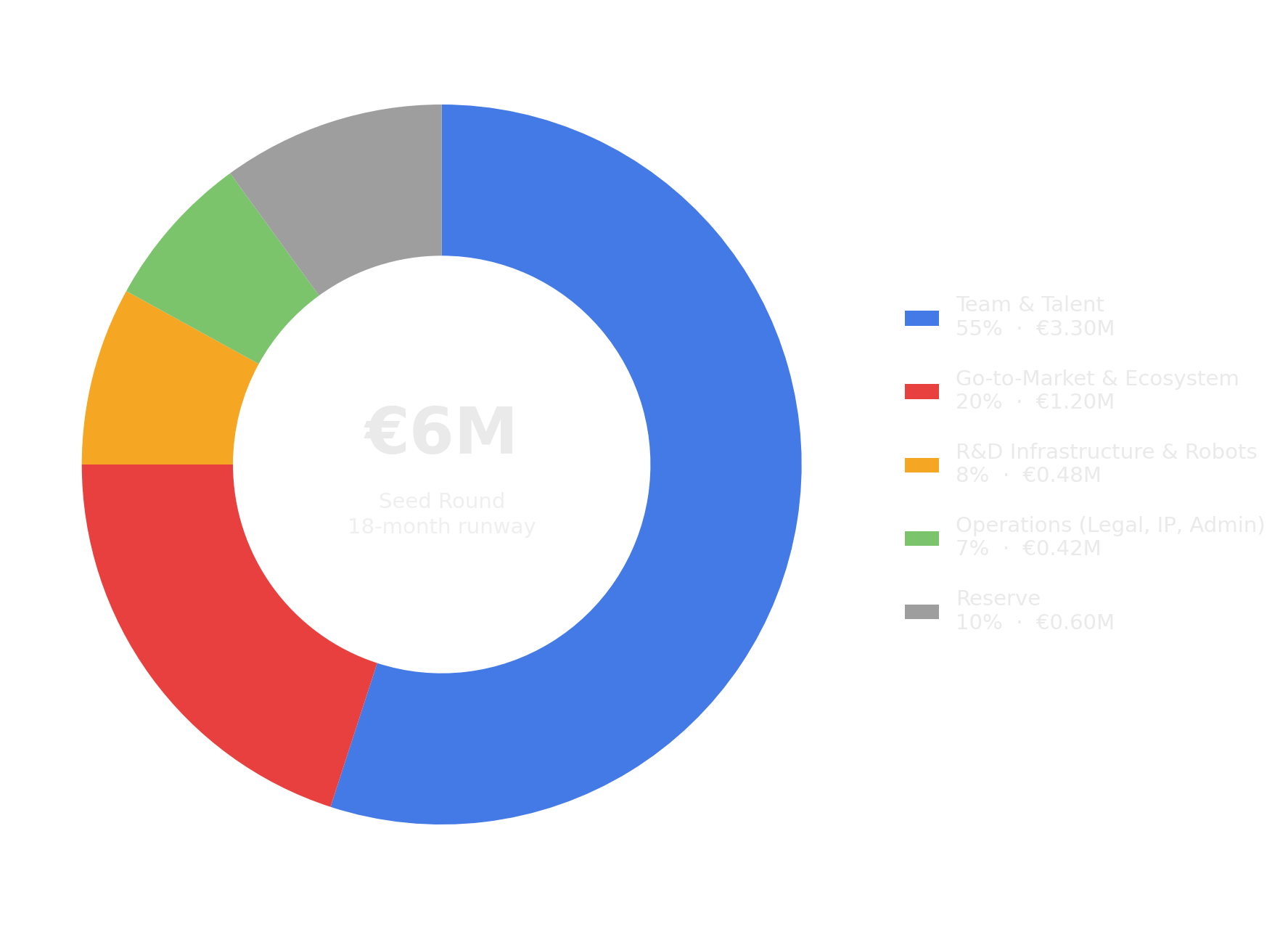
Allocation of the €6M round across the 18-month deployment window (Nov 2026 → Apr 2028).#
Category-by-category rationale
Team & Talent (55% · €3.30M) — Core R&D on Kompass and EmbodiedAgents, deployment engineers who bring EMOS to specific OEM hardware and customer sites, and a senior solutions architect to close OEM deals faster. Includes contractors pulled forward ahead of the FTE ramp to accelerate integrations.
Go-to-Market & Ecosystem (20% · €1.20M) — Direct commercial presence in China (Shenzhen desk + local BD contractor covering RealMan / Booster / HighTorque / Leju) and the US (Boston/SF desk + liaison for partner ecosystem), presence at 6-8 flagship expos per year (ICRA, IROS, ROSCon, WMF Shanghai, WRC Beijing, Automatica, VivaTech, CES Robotics), a full-time DevRel / evangelist function, content production, paid distribution, and sponsorships of open-source robotics communities (Nav2, ROS-I, Isaac Sim, OpenUSD).
R&D Infrastructure & Robots (8% · €480K) — Test fleet expansion: humanoid dev units (Booster / Unitree G1 / Fourier), mobile manipulators (RealMan arm + wheeled base), additional quadrupeds, GPU compute for training and CI, and simulation/CAD licences.
Operations (Legal, IP, Admin) (7% · €420K) — IP prosecution (patent PCT filings + international trademark portfolio across EUIPO / USPTO / CNIPA / WIPO), legal for OEM contracts and China entity setup, recruiter fees, BSPCE plan, corporate insurance uplift (RC Pro + cyber + product liability), finance and admin support.
Reserve (10% · €600K) — Buffer for timing risk on customer deals and hardware procurement lead times, sized to keep the runway resilient through the transition into the marketplace-launch phase.
Team Growth#
The hiring plan mirrors the two commercial waves in our go-to-market strategy: a first ramp in 2027 focused on integration and reference deployments, and a second ramp in 2028-2029 aligned with the marketplace launch and OEM scale-up.
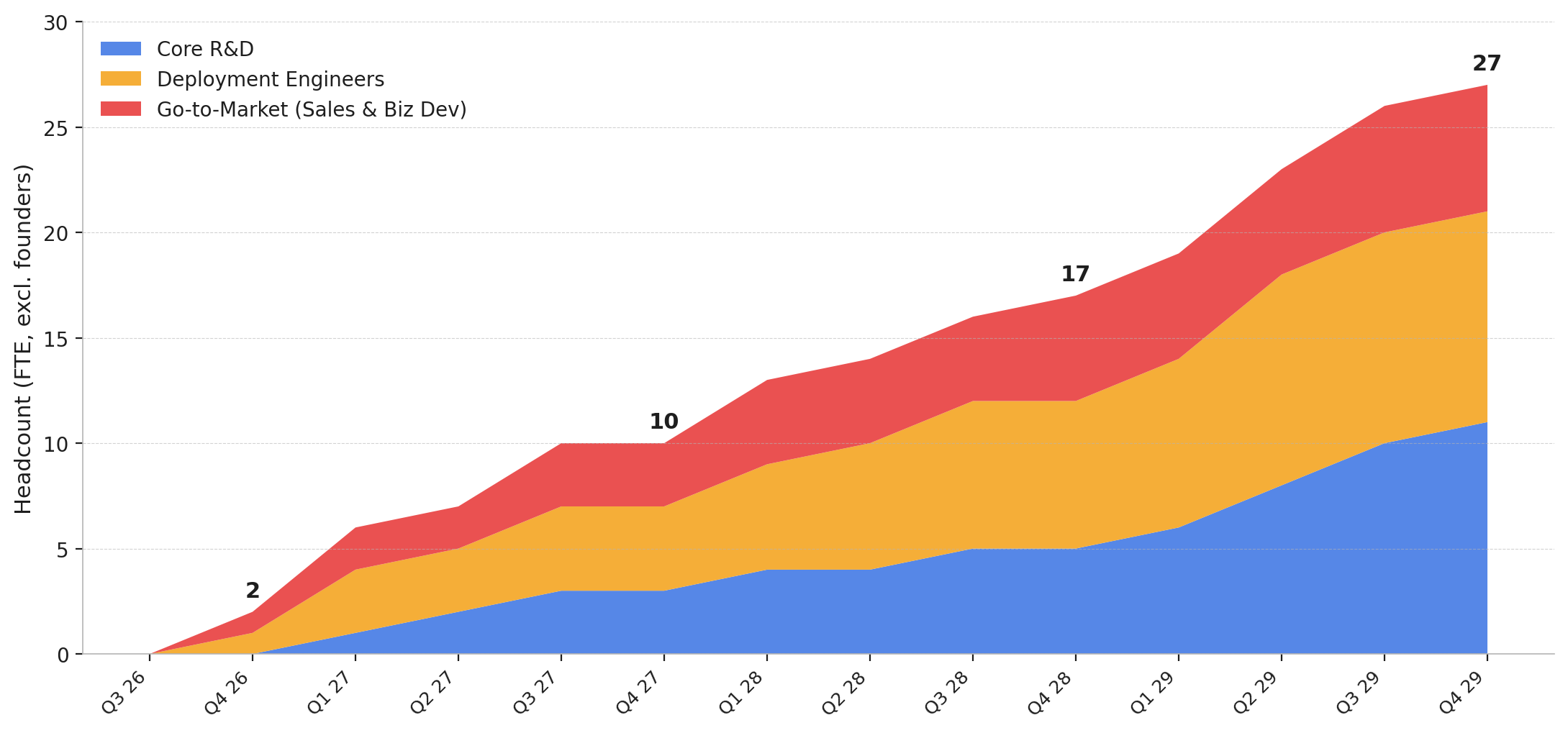
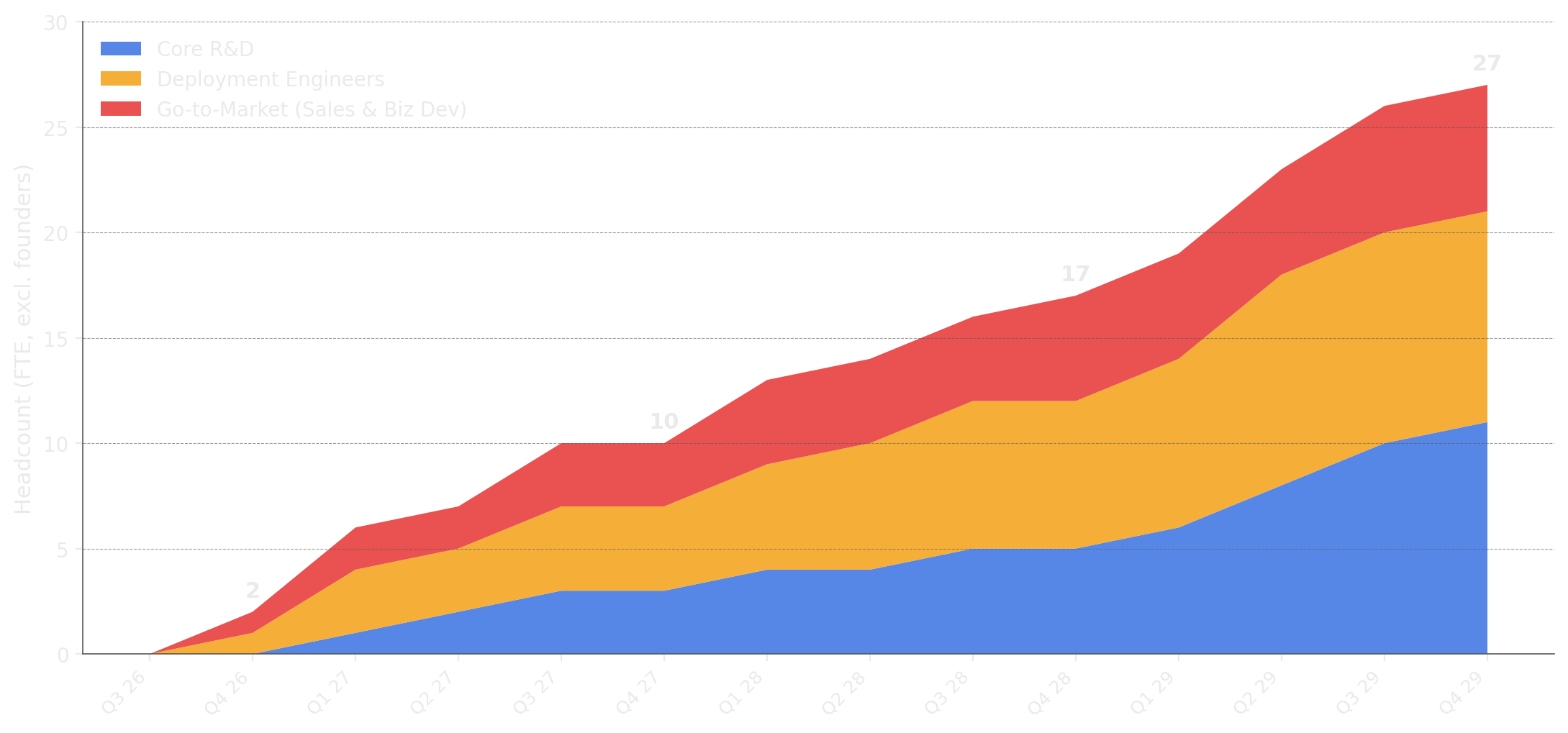
Quarterly hiring plan across the three functions that drive the plan — founders excluded.#
Core R&D grows from 0 → 11 FTE by Q4 2029 — senior software engineers on Kompass and EmbodiedAgents in 2027, applied Physical AI engineers as VLA-based manipulation matures. This is the bench that keeps the core stack moving.
Deployment Engineers are the largest single bucket in the early years, ramping to 10 FTE by Q4 2029 — applied engineers who bring EMOS to specific OEM hardware and customer sites (HAL plugins, recipe development, on-site enablement). This is the bucket that makes “deployable in days” real for OEMs and integrators.
Go-to-Market (Sales & Biz Dev) starts in Q4 2026 and reaches 6 FTE by Q4 2029 — direct sales and business development into humanoid OEMs (China + EU) and integrator accounts.
Total planned headcount excluding founders reaches 27 FTE by Q4 2029. A rolling internship channel (2 per intake, twice a year) runs alongside these roles as the pipeline into full-time conversions — not shown separately on the chart.
Revenue Model#
EMOS revenue rests on three complementary streams, each aligned with a distinct actor in the robotics value chain. This blend is intentional — no single line dominates in the outer years, which means the plan does not depend on the marketplace inflection alone.
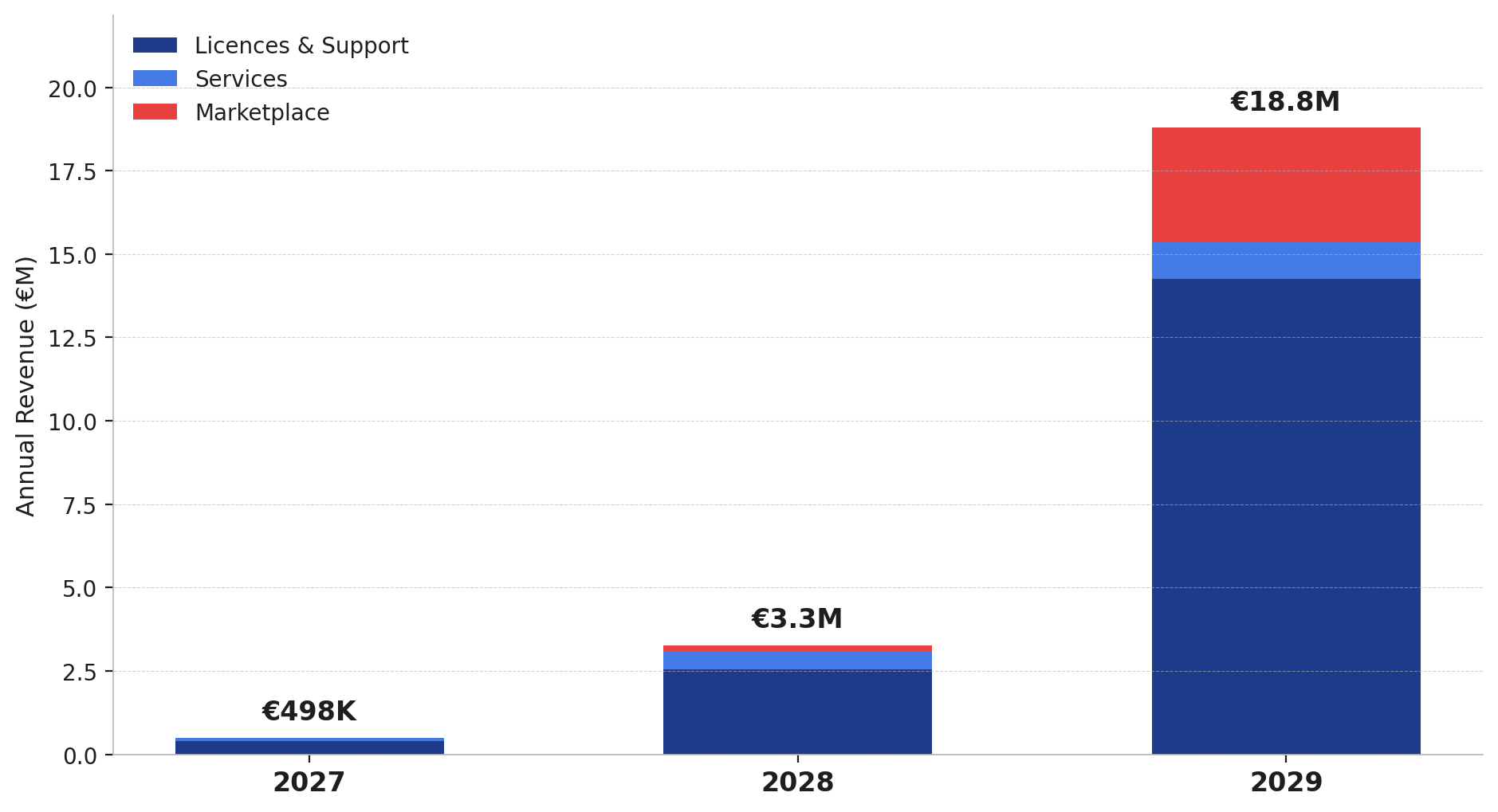
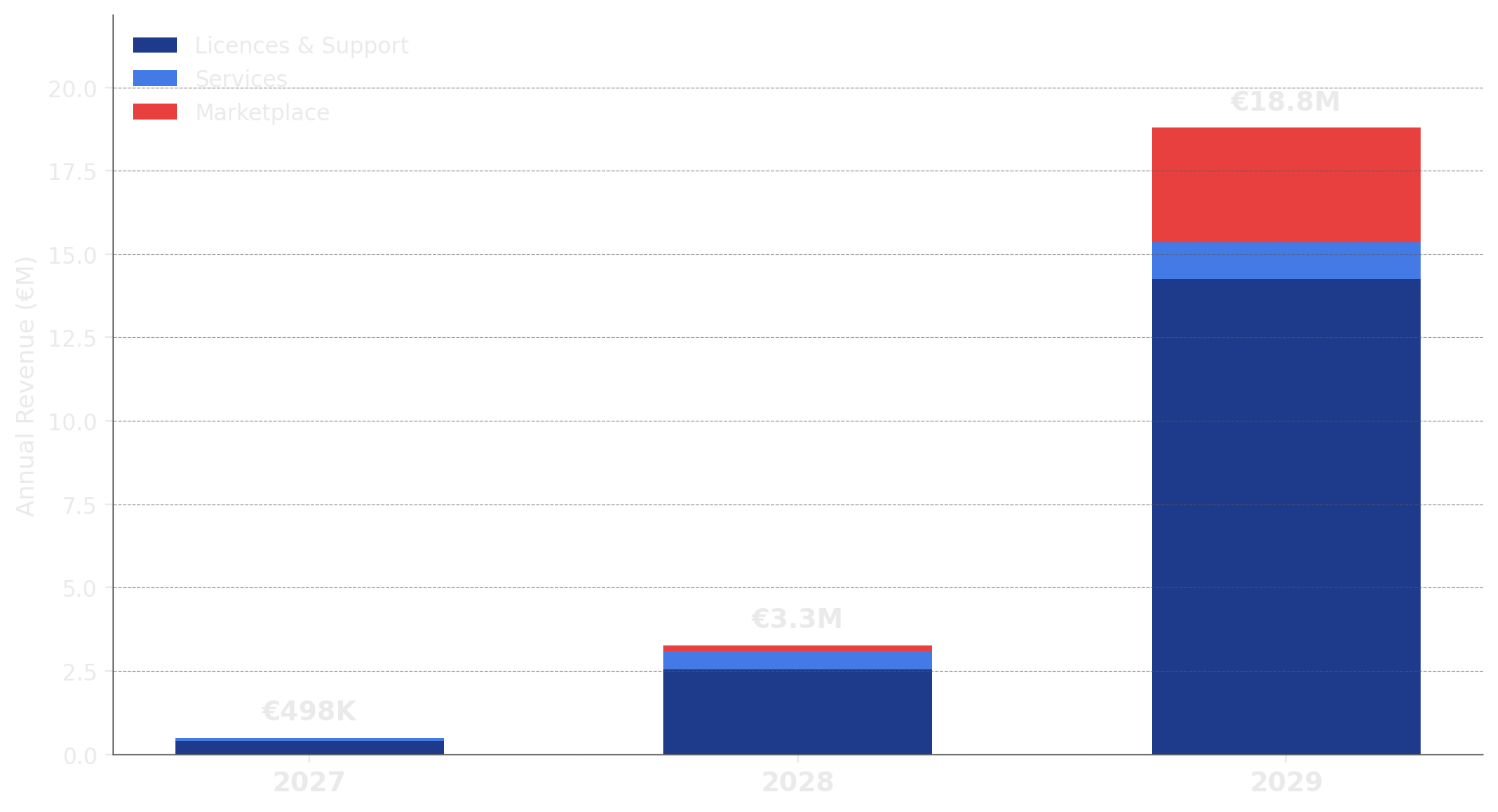
Projected annual revenue 2027-2029, split across the three streams.#
Licences & Support — Per-robot licences sold to end-users (directly or through integrators like Skysmart and M20), and pre-installed by OEM partners under revenue-share (DeepRobotics signed, humanoid OEMs in the MoU pipeline). Support tiers layered on top for enterprise buyers. This is the largest and most predictable stream once fleets deploy.
Services — Paid integration engagements — largely with OEMs and system integrators bringing new hardware into EMOS, plus a smaller share of custom recipe development for anchor enterprise customers (ESA Security Solutions is the reference). We keep this stream deliberately capped to avoid the “custom-project” trap that has held the wider robotics-software market back.
Marketplace — The EMOS Registry monetization engine launches from Q3 2027 onwards. Third-party recipe developers publish Apps to the registry, EMOS keeps a platform fee. This is the highest-leverage stream and the reason the 2029 line steps up sharply.
The trajectory assumes conservative attach rates on OEM-shipped fleets, no new large enterprise deals beyond the currently-visible pipeline, and marketplace GMV ramping only after the trust-and-safety framework is live.
Detailed Financial Model#
The full model — quarterly P&L, cash flow, headcount plan, unit economics per stream, and the underlying assumptions sheet — is available on request.
Request the detailed model
Please reach out to us at haroon@automatikarobotics.com and we will share the full Excel model along with a walk-through call.